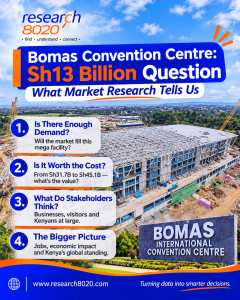


Sh13 Billion More for Bomas? The Big Market Research Questions Behind Kenya’s Sh45.1 Billion Convention Centre
Kenya’s ambition to position Nairobi as a leading regional meetings and events destination is facing a major financial test. With the cost of the Bomas International Convention Centre reportedly rising from Sh31.7 billion to Sh45.1 billion, questions are emerging not only about public spending but also about the project’s economic viability, market demand and expected return on investment.
Infrastructure projects are often presented as symbols of economic transformation. But beyond the architectural designs, construction milestones and government promises lies a more important question: Does the market justify the investment?
The Bomas International Convention Centre project has brought this question into sharp focus following reports of a Sh13.4 billion increase in its approved cost and revelations surrounding a previously undisclosed 390-page contract linked to the Ministry of Defence.
According to details reported by The Standard, the project’s cost has increased from Sh31.7 billion in 2023 to approximately Sh45.1 billion.
Among the additional costs highlighted are Sh856.8 million in design fees, Sh4.97 billion in flat import taxes and Sh3.56 billion allocated for presidential fit-out.
While government officials defend the project as strategic infrastructure, the developments present an opportunity to examine a critical aspect of public investment: the role of market research in determining whether large-scale projects deliver economic value.
1. Beyond Construction: Is There Enough Market Demand?
Nairobi has established itself as an important destination for business meetings, conferences and international events. However, the existence of a growing meetings, incentives, conferences and exhibitions (MICE) industry does not automatically guarantee the commercial success of every new facility.
A comprehensive market demand assessment would be necessary to establish whether the proposed convention centre has sufficient demand to justify its investment.
Such research would examine:
The number of international and regional conferences hosted in Nairobi annually.
Demand for large-capacity conference and exhibition facilities.
Average venue occupancy rates and seasonal demand patterns.
Pricing expectations among corporate clients and event organisers.
Competition from existing conference facilities in Kenya and neighbouring countries.
The likelihood of attracting international events currently hosted in competing destinations.
These indicators would help establish the project’s potential market size, revenue opportunities and long-term sustainability.
The critical question is not simply whether Kenya needs another convention centre, but whether the market can sustain one at the scale and cost being proposed.
2. The Sh13 Billion Increase: What Does It Mean for Project Viability?
A reported increase of approximately Sh13.4 billion in project costs changes the financial assumptions behind an infrastructure investment.
From a market research perspective, a substantial cost variation should prompt a reassessment of the project’s financial viability.
For instance, how much additional revenue would the facility need to generate to justify the increased investment?
Would higher conference bookings, international exhibitions, corporate events and hospitality spending be sufficient to support the additional expenditure?
A proper investment assessment would consider projected revenues, operating expenses, maintenance costs, expected occupancy, financing arrangements and the period required to recover the investment.
It would also examine the opportunity cost of committing additional public resources to one project instead of alternative investments in transport, healthcare, education or other economic sectors.
Without reliable demand forecasts and transparent financial projections, determining whether the additional expenditure represents value for money becomes difficult.
3. What Do Stakeholders Actually Think?
Large infrastructure projects are not evaluated by construction progress alone. Their success also depends on how different market participants perceive and interact with them.
Market research can help establish the expectations of the stakeholders who will ultimately determine the project’s relevance and utilisation.
These include:
Event organisers: Are the proposed facilities, capacity and pricing competitive?
Corporate organisations: Would businesses consider hosting major conferences at the venue?
International delegates: Does Nairobi offer the accessibility, accommodation and services required for major events?
Hospitality businesses: What opportunities could increased conference activity create for hotels, restaurants and transport operators?
Local communities: How do residents perceive the investment, its costs and its potential economic benefits?
Stakeholder surveys, focus group discussions and industry interviews could provide valuable insights into the project’s anticipated reception and actual market potential.
Importantly, public perception also matters. Reports of rising project costs and limited contractual transparency can influence public confidence in government-led investments.
Understanding these perceptions requires evidence rather than assumptions.
4. Can the Convention Centre Strengthen Kenya’s Regional Competitiveness?
The ambition to position Nairobi as a regional business and events hub requires more than the construction of a modern facility.
Kenya must compete with established and emerging MICE destinations across Africa.
A competitive market assessment would compare Nairobi with destinations such as Kigali, Addis Ababa, Johannesburg and Cape Town.
The research would examine:
Conference infrastructure and venue capacity.
International flight connectivity.
Accommodation availability and pricing.
Business tourism expenditure.
Event hosting costs.
Destination reputation and international competitiveness.
Government support for the events and tourism industry.
This benchmarking would help establish whether the Bomas project addresses an existing market gap or adds capacity to an already competitive environment.
It would also identify the improvements required beyond infrastructure to attract international conferences and generate sustainable economic activity.
5. Jobs and Economic Growth: Measuring the Real Impact
The government has defended the project by pointing to employment opportunities and its potential contribution to economic development.
However, the actual economic impact of such an investment should be measured.
Economic impact research could establish the number of direct and indirect jobs created during construction and eventual operations.
It could also assess opportunities for local suppliers, transport providers, accommodation businesses, food vendors, event management companies and other service providers.
Another important consideration is the economic multiplier effect.
When international delegates attend conferences in Nairobi, they spend money beyond the convention centre. They use hotels, restaurants, transport services and other local businesses.
Research can estimate how much of this expenditure remains within the local economy and how much additional economic activity the project generates.
The distinction is important: a large infrastructure investment does not automatically translate into equally large economic benefits.
6. Transparency and Public Confidence: Why Data Matters
The reported 390-page contract and the controversy surrounding direct procurement have introduced another important dimension to the discussion: public trust.
With the project’s cost reportedly increasing to Sh45.1 billion, questions about procurement, contractual obligations and additional expenditure have become central to public debate.
From a research perspective, public confidence is an important indicator of institutional credibility.
Regular public opinion surveys can help assess whether citizens believe government investments are justified, whether they understand the expected benefits and whether they have confidence in the institutions responsible for delivering them.
Transparent reporting, accessible project information and independently verifiable performance indicators can help bridge the gap between government promises and public expectations.
The Bigger Question: Are We Measuring Infrastructure or Economic Value?
The Bomas International Convention Centre presents Kenya with an ambitious opportunity to strengthen its position in the regional business tourism market.
However, the reported cost increase provides an important reminder that infrastructure development must be supported by credible market intelligence.
Before committing billions of shillings to major projects, decision-makers need reliable answers about demand, competition, stakeholder expectations, financial sustainability and measurable economic impact.
Market research is not simply about collecting opinions or producing reports. It is about generating evidence that helps governments, investors and businesses make informed decisions.
For the Bomas project, the conversation should therefore extend beyond how much it costs and when construction will be completed.
The bigger questions are whether the market needs it, whether the investment can deliver sustainable returns, who stands to benefit and how those benefits will be measured.
Because in a changing economic environment, successful infrastructure is not defined by how much money is invested, but by the measurable value it creates.